Saturday, 7 March 2015

The Turning Point

In the middle of this paragraph I will reach  fourteen thousand words towards this project, before the sunsets on my fine art A-level I’ll have probably written twice that (sorry). But this is the point in the project where I make my turning point, I’ve written about four artists in detail and nine more loosely, I’ve looked and dozens of works and covered three questions, I’ve come up with several design ideas and I’ve explored numerous avenues. My design Ideas were meant as four options, I’d pick one and progress, but is that true refinement? For each of my designs I’ve found the cusp of what makes it exciting and interesting and I think it shows more refinement to take that single good element and combine it into one mantra for my final piece. I want to move away from how I normally work and I want to spend the second half of my project looking at more artists and trying out more things so that at the end of the process I have a single excellent, refined and well developed final piece.

To describe my final design theres a long story and a short story, read whichever you wish.

The Long Story

Medium

I’ve looked at several mediums and in the development process of my final piece I’ll explore more to find the best suited to my idea. But I’m not going to avoid the obvious truth that my final piece is likely to be an example of multimedia assemblage. How can it not be? It’s what I do best, all the work I’ve done up to this point has elegantly proved that although I’m not a one trick pony I do one trick better than any other.

The concept

I want to create a work about the relationship between my art and engineering, this links to the question, makes the work personal to me and links to my underlying theme. My design idea Inken Cities looks at urbanisation into nature and my work on apocalyptic artists looks at the relationship between artists and technology. So for my final design I want to explore the idea that technology and engineering is surpassing artistry. For me the whole point of art is to do something for its own sake, it doesn’t need a purpose it’s just about creating something interesting for entirely selfish needs, machinery always has a function art doesn’t. The repurposing of a book in my POW escape kit prompted the idea that I could use scrap objects, rejected technology and machinery and rebirth it as a piece of functionless art. Making my skull I used waste products to create art and this idea can take the satiristic twist I used in my POW kit to use discarded machinery and technology to create a piece of art. The satire is that I’m mocking the fact that maybe one day I’ll be replaced by a 3D printer by using other pieces of machinery to create art, I’m taking objects with a function and using them for art. By repurposing junk I’m explore the relationship between humanity and lifeless object which I looked at in my apocalyptic artist and showing not only how fleeting that relationship is but how as an artist I have a purpose because I’m making something out of discarded objects.

The Piece

The final piece itself will be a collection of scrap objects, pieces of machinery and outdated technology that come together to create something visually interesting. I want the whole work to be kinetic, I want it to move because that separates it from my previous static works. I want the work to be created from object that used to have a practical everyday function and I want to morph them into an object which only function is to be a piece of art.

The Links

This idea links to every piece of work I’ve done so far for this project, because this idea was born from the research and exploration I’ve already done. This work links to Andrew Wyeth because I accept I can’t paint like Wyeth but I can strive to create a work as meaningful and deep as his. It links to Giles walker because I’ll use scrap and found object which have been discarded by people to create a new piece of meaningful art. This idea links to Da Vinci’s sketchbooks because I will use the beauty of mechanical forms to create an aesthetically beautiful work. Most obviously it links to the work of Theo Jansen because I want to create a piece of work which moves and intrigues and I want to create something which is both engineeringly amazing and artistically, just like his strand beasts.

I have done four design Ideas and take an aspect from each and blended them into this final design. My POW escape kit influence this project because the repurposing I used in that has inspired my idea to create a final piece made of repurposed objects. My mosaic waste product skull looks at the use of discarded objects to create something beautiful and that’s what I aim to do in the final piece. Inken Cities looked and the interplay between people and urbanisation, this work will take that further and look at the relationship between artists and technology. Finally in my post EMP artist idea I explored what a bare bones artist would look like and I thought about what an artist would do if the world as we knew it ended, the world as we know it is changing every day because of technology so in this piece I can explore where the modern artisan stand in the face of modern engineering.

Of course I’ve taken this project on a merry jaunt to the bare extremes of my question ‘Relationships’ but this idea explore the relationship between my art and the engineering and creative processes which go into its production. The underlying problem with all my design ideas is they lacked a personal to me aspect which I was really passionate about but this idea lets me combine my passion for making things I had as a child and the great transition  I’ve made from wanting to invent thing to have a purpose and improve the world to want to make art which improve the world by being interesting and meaningful.

The Short Story

I’m going to create a work of assemblage made of scrap and discarded pieces of machinery and technology. This work will be kinetic and will take object which have a everyday function and give them a single function of being a piece of art. It will look at the relationship between artists and technology and explore my personal transition between making things for a function and making things for art.

The Really Short Really Refined Story


I’m going to make a big-ass sculpture which will move and mean… many things.

Friday, 6 March 2015

Design Idea - Apocalypse Soon

The world didn’t end in 2012, and 2012 (the film) didn’t end the never ending stream of  apocalypse films and TV shows. Theres so many films about the end of the world I think we can all agree we don’t need the world to end to appreciate what it would be like. Theres many things that seem to be probable causes for the end of the world; global warming, freak weather, solar flares, earthquakes… South Koreans. However the one I find most interesting is the possibility of a global or localised EMP attack, an EMP is an electromagnetic pulse which would completely destroy all electrical devices. Now I find the idea of this extremely interesting, because at the moment I’m typing this intro on an Iphone app, and then I’ll post it on a blog to hopefully be read by people on computers and smartphone. It’s hard to imagine life without any electrical devices, this whole project is about technology and engineering and its relationship to humans which is seemingly symbiotic. For this design idea I create a model of a post-apocalyptic artist, I wanted to explore the idea of an artist living in a dystopian future. If the world as we know it came to an end would there still be artists or would they be two busy scavenging for food and running from oppressors?. I didn’t want to answer this question because it would be too extensive so I created an artist free of all technology and living in a harsh post-EMP apocalypse. This work was inspired by Colby Vincent Edwards’ series ‘The 8th Day’ but also influenced by the bleakness of Wyeth’s paintings and the creation methods of Giles Walker. If I wanted to continue with this design I would look at other artists who have works with themes of post apocalypse or who have looked at the relationship between technology and art and I would research doomsday preppers, people who prepare for the end of the worlds.

I created this work to explore the ideas of apocalypse inspired art and looking at the relationship between artists and technology. I started with an artist’s mannequin, the wooden things people are supposed to use to help them draw but actually just keep round to look decorative and then removed some parts of it. I took out the upper left arm, head and lower left leg, I made clothes, out of loose weave hessian material and hairy string and I replaced the missing parts with everyday objects. I wanted to depict a person who was well worn and tired looking, I liked the idea that the person was rebuilt out of scrap objects, the arm is an old key, the head is a collection of wood and metal and the peg leg comes from fire damaged wood. The model has an intentionally grungy style but is made to look like a realistic stripped back artist might look. The work was inspired by Colby Vincent Edwards’ series ‘The 8th Day’ but also influenced by the bleakness of Wyeth’s paintings and the creation methods of Giles Walker, I took elements from these 3 artists and combined them to create a strong piece.  I think the assemblage sculpture was highly effective it has a really good look to it but I think that as a theme for development it’s stunted. The idea of looking at a post-apocalyptic artist is good but hasn’t go the legs to be a basis for the whole project, what does have a lot of room for development is looking at the relationship between artists, technology and engineering. I think the exploration of this design Idea has prompted me to refine the progression of my project, instead of just looking at the relationship between art and engineering I will look at the relationship between artists and the use of their technology as well as how I use engineering in my sculptures. 

Design Idea - Wasted Skulls

Skulls are powerful symbolism and something I’ve dabbled in before, I like the idea of creating a series of skulls in a variety of mediums. I would like to look at the hidden side of creation, I want to make art from the waste products of production. Everything that is made in a factory comes with a degree of waste, these days it’s recycled and all is well in the grand scheme of thing but theres still waste. My idea is to make a series of skulls out of modroc and plaster all from the same mould and then encrust them with the waste products of manufacture. When I say waste products I mean off cuts and misshapen pieces all the little bits of material that are wasted when making things. The idea came to me when I was thinking about Giles walker's work and how I could interrupt it in my own way, I always wanted to look at the idea of using a skull as an emotive life study similar to the work of Wyeth. I just happened to have two large jars full of glass tile offcuts so I used them as my first waste material, I used a polystyrene head as a mould and built a skull cap cast out of modroc. Once I had a well-shaped skull cap I built in the mask and jaw then painted the whole thing to seal it. From a personal aspect making skulls is something I’ve done a few time before and am determined to improve on. If I continue on with this design idea I’d better research the shapes and construction of skulls and I’d look into an variety of waste products in varying materials like rubber, wood and pottery.

I created a skull out of modroc and encrusted it with glass fragments to create a work which explored the idea of using waste material to create art. My research into Giles walker strongly influenced this piece because like this work this exploration uses scrap material to create art, also I’m trying to explore the relationship between life and art which is well documented in Theo Jansen’s work. I had to do a little research into skulls to make sure I had an accurate form and I got to practise using modroc to create complex shapes. My modroc skull had a few minor collapses and cave ins but by using filling techniques I could overcome this. The uneven and rough surface of modroc along with its strength lend itself to this piece, I considered using other mediums like cardboard as a base but these mediums lacked the rigidity of modroc. Modroc’s texture and rough finish lent itself to adhering the glass fragments and to offering a realistic effect. I think this sculpture was successful, the overall aesthetic is effective and it links well to the ideas I wanted to explore however in future I would want to improve the mould and shape of my skull to make it realistic. My piece lacks details and is far from an accurate scale all things I would want to address If I went further. I have learnt that modroc isn’t the best material for sculpture, it’s expensive, hard to mould smoothly and brittle, although suited to this piece in future I will use other mediums. I have enjoyed using scrap materials to create art, using refuse and recycling it is excellent both aesthetically and ethically so I would want to continue this idea in future work for this project.


Wednesday, 4 March 2015

Design Idea - The book is Mightier than the Sword

A wise man once said that necessity is the mother of creation, he was only partly right. War is the mother of invention, its well documented that the greatest leaps in technology and medicine come about during wartime. Why is this? War tend to prompt urgency and both sides are trying very hard to either cause or avoid death. Now war is also a hotbed for art, various conflicts have prompted some of the greatest works of art ever. Both things in mind for this design Idea I explore war and invention in my own arty way. Instead of war as a whole I looked at POW escape kits, I’ve seen a lot of documentaries about the creative ways which the British government sent escape equipment to POWs. I was torn with this idea which angle of war to look at, whether to be satirical or serious, pro or anti-war, so I decided to do all at once, just like in popular American sitcom M*A*S*H. I research the sort of things that went into escape kits and came up with some ideas of my own. What to contain my escape kit in was obvious, the whole point was for it to look inconspicuous so I did the classic idea of hiding it in a book. I happened to have a very old compilation of Wordworths poems hanging around and decided it would be the perfect base for my kit I was planning to hollow out the pages but that far more difficult and laborious than you may think. Instead I replaced the pages with a box frame then painted the edges to look like pages. I won’t mince words I really enjoyed making this model for this design idea however I don’t really feel it relates well to my themes or question. This work link to my research into Da Vinci because it a piece of art where the elements as a collection are greater than the sum of the parts, much like his sketchbooks, and it links to the inventiveness and wit of Theo Jansen. I’d hoped to look at the relationship between warfare and invention however I think there are more fruitful avenues to take. That being said if I do continue with this design idea I would further research war artists, POW camps and military gadgetry.

Prison Of War Kit Inventory
Sterilised Surgical Needles for first aid
Microfiche of travel documents, permits and maps
Orders Envelope
Cork for making a compass with a magnetised need or for containing beverages
Magnifying lens for starting fires, enlarging microfiche and looking at small things
Needles for sewing, making compass
Roll of cotton for surgical or textile sewing
Paper String for strangulation, restraint and parcels
Pills assortment, aspirin (white), cyanide (red), penicillin (blue), anti-depressants (green) – Colours may vary
Dice for gambling with German/fellow inmates
Gold star for bartering with peasant girls, impersonating an officer
Lead Pencil for writing notes, planning escapes, collating memoirs
Trip/Garrotting wire, for tying between trees
Liquid Solvent for adhering or inhaling
Key (to open cell door)
Small Camouflage Material  for deception
Small Leather Change purse, prevents change rattling when running away from Germans
Coins for tossing or spending
Small Portable Window for seeing out of buildings
Penknife, for stabbing, cutting and trimming of facial hair#
Postcard to send to loved ones post-escape


Of all the pieces I’ve created so far for this project this is one of my favourites, I had the idea to create POW escape kit rattling round my brain but it only came to flourishion when I saw a little book of Wordsworth poems to use as a receptacle. I’ve seen the great escape enough times on boxing day to know about escaping a POW camp, based on my limited historical knowledge I collected and made objects to put in the book box, a list of which is above. My research into Da Vinci influenced this as well as looking into the creativeness of The Jansen, to actually make the book box I employed techniques I learned in making my own Da Vinci Style Sketchbook. I feel this study was one of my most successful so far because it is visually interesting, meaningful and as well as being well thought out and powerful it’s got a little bit of wit and humour too it. the problem is that I feel some people will question to what extent it shows artistic skill. One of the best elements of the piece is the reuse and repurposing of a old book into something more artistic. This piece had very interestingly explored a concept but brought up two things I find intriguing and would like to develop, the elements of satire I employed within the work and the repurposing of an old unloved object. These two elements are the most intriguing and have the most room to develop from this piece, from a media and technique point of view this piece is very much in my style, it’s a collection of object which as individuals are uninteresting and meaningless but are as a whole a piece of powerful art. In this project I am as I have in the past leaning towards an idea of creating a piece of assemblage. 


Design Idea - Inken Cities

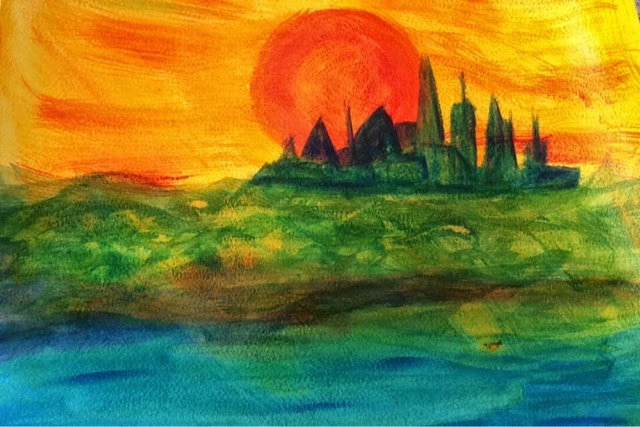
I've been doing art a few years now and I've found my niche, but also I think sometimes I need to branch out and try new things. One of my design ideas is to explore city scapes in 2D mediums, I know this is unimaginative based on the fact my whole last project revolved around cities. Looking at the drawings of Da Vinci I appreciated the great skill it must take to draw such detailed images in ink. On a cold drizzly afternoon I did a little experimentation with a small brush and yellow, blue and red ink and did some doodle to explore ink as a drawing medium. I found it hard to get crisp fine lines like the kind in the sketchbooks of Da Vinci so I went off message and started doing abstract flowing lines instead. After a little experimentation I was left with what appeared to be a woman straddling a burning tree with no arms, at this point I immediately abandoned figure drawing. Instead I create a little city scape framed by rolling hills, a flat sea and a sun setting sky. Having travelled all over the world to a lot of cities I always find theres parks and gardens to bring in nature to the urban abyss. It could make a very interesting final piece to explore the relationship between nature and urban environments. This would link well to my question and it would explore my theme of machinery, all be it in a residential format. This work was inspired by Da Vinci at first but embraces a more impressionistic feel as I developed my use of ink, If I carry on with this design idea I would look and skylines and painters. My issues with this design is it moves away from doing what I really love which is sculpture and it might be unwise to use a medium I’m not very skilled in.


I wanted to do at least one piece for this project that is traditional artistic flat mediums, and my idea to look at engineering in cities and how it relates to nature and social relationships was well suited to ink drawings. This work was inspired by Da Vinci in regards to its medium but it’s subject is one I've researched extensively in the past. I wanted to look at the interplay between nature and urbanisation and to explore the most common engineering feats; urban settlements. The work wasn't wonderfully successful, I achieved a good visual effect but didn’t demonstrate a massive amount of skill, I used a variety of brushes to create the image out of ink and then used watercolour markers to pick out detail, high and low lights. To finish off the piece I sprayed it with a UV spray which blended the colours and gave it a shiny finish like a photo graph or acrylic painting. It is not so much what I have learnt but what I have reaffirmed from this piece which will influence the future of my work, I am greater gifted in 3D than artist mediums with one less dimension, for the remained of this project I’ll stick to mainly sculpture and assemblage however I will still do some drawings in various mediums to support my work. Part of this work was to explore urban engineering, buildings and the urbanisation of the world, with this in mind what I’ll take form this idea is to look at how engineering and technology is starting to permeate every facet of modern life. 

Evaluation of Da Hoadley's Sketchbook


I did a large series of technical drawings of various engineering concepts I have knowledge of, after doing this I boud all these images to create a sketchbook like manuscript similar to the sketchbooks of Leonardo Da Vinci I have researched earlier in this project. The intention of this series of work was to explore the methodology of Da Vinci whilst also showing and developing my preexisting knowledge of engineering and mechanical concepts. I also wanted to practise technical drawing a skill I may need to use again at later stage in this project, although i’m not best suited to drawing it is a necessary skill, unfortunately. This work was inspired by the research I did into Da Vinci but the knowledge displayed within the book came from my memory and is based on things I’ve been taught or learned through research in my earlier life. I feel the work work was successful in that it fulfilled its purpose, however I think that my lack of drawing skill drag down the quality of work and meant it didn't look as engaging or authentic as I could have hoped. In the future I plan to continue to use a vintage aged look in my works but I will avoid the more two dimensional mediums. My next step will be more artist studies and evaluation followed by design ideas.

Evaluation of Beach Beast (TBF)

I had originally planned to create a moving kinetic sculpture for this artist study, I created a maquette which explore how the leg motion of one of theo jansen designs works to see how a working model could be created. I decided to curb my ambition and instead make a work which explore the aesthetic side of Jensen's work. I create a model out of lolly sticks and foam board which was based on the structure of a crab or other aquatic crustacean. I used lollysticks as my primary medium for two reasons, firstly they are a cheap and easy to construct with just like the materials Jansen uses, secondly they are an object found regularly at beaches which links to the idea of the work being a beach creature. The Beach Beast has six legs each of which are a slightly different design, I wanted to explore a variety of different leg shapes, Jansen's creature are very symmetrical and all share a similar leg design. I created this work to explore Jansens work and to look and both construction and kinetic art techniques, I also wanted to develop the idea of using junk and scrap materials to create art. The maquette is successful and aesthetically pleasing it is however not kinetic or my finest work of art. I want to learn more form Theo Jansen's ethos than his actual work, the idea of art that lives, moves and seems to have sentience is something I wish to explore in my future work. The work turned out to be aesthetically interesting and it was amusing to create, while making it I practised some creation techniques I will use at a later stage in my project. My next step will be more artist studies and evaluation followed by design ideas.